
Agile Consulting & Training
Your portfolio isn’t the problem. Your operating system is.
PPM4Agile is a portfolio operating system for organizations whose strategy and delivery have come apart. It runs on four connected practices, Align, Focus, Deliver, and Learn: Align decides what matters, Focus proves you can deliver it, Deliver executes the committed slice, and Learn measures what shipped and feeds the next decision. Six operational drivers carry the practices: workflow, meetings, people, metrics, artifacts, and the tools pipeline.
Led by B. Eric Fullerton, creator of PPM4Agile, with more than 20 years across IT operations, project and portfolio management, consulting, and agile coaching. Organizations he has worked with, as an employee or through client engagements:
The pattern
Sound familiar?
These are the complaints that come up in the first five minutes. They sound like delivery problems. Usually the cause runs end to end, from how projects get picked to how the work is recorded and tracked.

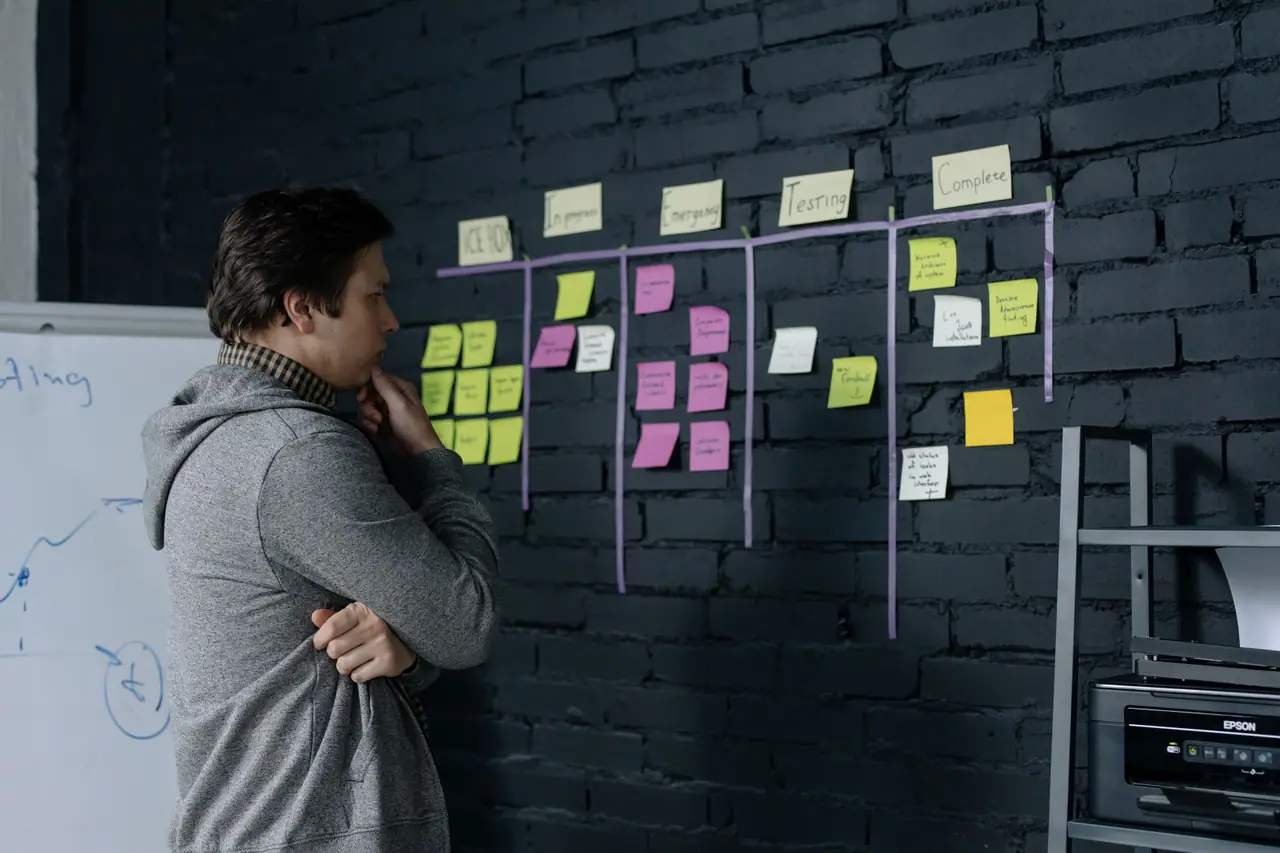
Business and IT blame each other
The business says IT is always late. IT says the business is unclear, unavailable, or keeps changing its mind.
Late, over budget, and scope that won’t sit still
Timelines slip, budgets overrun, and the scope never settles long enough to plan against. The trouble sits somewhere in that triangle of scope, schedule, and budget.
Execution takes the blame
“The developers are too slow.” “QA misses things.” The real cause runs end to end: which projects get picked, whether anyone sticks to them, and the extra work that slips in.
Tools that don’t talk to each other
One group works in one tool and the next group in another. Someone syncs them by hand, errors creep in, and nobody can see the whole pipeline.
No record of what was asked for
Everyone documents requests their own way, with no standard and no common source of record. Months later the blue widget ships, and nobody can say what was asked for, or what wasn’t.
Free self-assessment
How healthy is your portfolio? 2-minute check.
Answer 10 plain-language questions about how work really gets chosen, planned, delivered, and measured. You get a score for each PPM4Agile practice and the one change most likely to help first.
- About two minutes
- No email, no sign-up
- Answers stay in your browser
Preview of the results view: an overall score out of 100, a bar for each of the four practices, and the practice to improve first.
The shift
What changes when you manage the system, not the projects?
Projects are outputs. The decisions about intake, capacity, cadence, and evidence are the system. Fix the system and the projects get easier to run.
| The old way | The shift |
|---|---|
| Manage projects | Manage the system that produces them |
| Plans built on assumptions | Plans validated against real capacity |
| Status by activity | Status by outcome |
| Every request accepted | Explicit intake and deferrals |
| Framework compliance | Decisions that hold |
The system
How does PPM4Agile connect strategy to delivery?
Four practices, one loop. Align decides what matters. Focus proves you can deliver it. Deliver executes the committed slice. Learn measures what happened and feeds it back into the next Align decision.
- 1Portfolio Development
Align
Turn ideas and requests into an approved, prioritized portfolio, with the reasons written down.
The question it answers: How do we decide what actually belongs in the portfolio?
A ranked portfolio your leaders can defendA written list of what you’re not starting, and whyYour operating system, set up for how you actually workExplore Align → - 2Planning
Focus
Turn one approved project into a plan someone can actually execute.
The question it answers: Can this plan survive reality?
A plan built on the people you actually haveAn MVP everyone agreed toDependencies with owners before work startsExplore Focus → - 3Execution
Deliver
Execute the committed slice and finish it, with a real hand-off to operations.
The question it answers: Why is everyone busy and nothing is finishing?
Work that finishes, in slices small enough to measureA release decision made on evidence, not the calendarA release operations can actually support, with a named ownerExplore Deliver → - 4Evaluation, Value & Learning
Learn
Measure what shipped against the goals it was funded for, then scale, sustain, or retire it.
The question it answers: How do we know any of this worked?
A clear call on what to scale, sustain, or retireValue measured against what the work was funded to doEvidence that makes the next Align decision easierExplore Learn →
What is a portfolio operating system?
A portfolio operating system is the set of decisions that connects individual projects: what gets into the portfolio, what a plan has to prove before anyone commits to it, how much work runs at once, and what evidence counts as progress. Most organizations run one by accident. Intake goes to whoever asks loudest, capacity is assumed rather than measured, and status reports track activity instead of outcomes. The result is familiar: the business and IT blaming each other, dates and budgets that slip, and leaders who cannot see whether anything is working. PPM4Agile makes that system explicit through four connected practices. Align decides what matters and writes down the reasons. Focus proves one approved project can be delivered by the people who will actually do the work. Deliver executes that committed slice and hands operations something supportable. Learn measures the result and feeds it into the next Align decision. Six operational drivers carry it: workflow, meetings, people, metrics, artifacts, and the tools pipeline. A seventh piece, OCM OS Governance, runs through all of them and decides whether the system becomes how the organization actually works. Because it works above delivery methods, it runs alongside SAFe, Scrum, or none of them.

Why StudioBE
Why does PPM4Agile hold up?
Public or private, the industry matters less than how many IT projects you coordinate. PPM4Agile gives everyone one framework to work from, with known inputs and outputs, so the business, IT, and the tools between them stop working in silos.
We fix how the whole system works, not one part of it
The trouble usually starts upstream of the projects, in how work is chosen and planned. We work the pipeline end to end, teams included.Framework-neutral
PPM4Agile works with SAFe, Scrum, Kanban, or none of them.Built for organizations running many projects
Public or private, the industry matters less than how many IT projects you have to coordinate. Procurement, oversight, and mandates are inputs, not excuses.Decisions leaders can defend
Every prioritization call has a visible rationale.No big program, one shared framework
You don’t need a big transformation program to start. You do need one end-to-end framework that everyone works from.
Who you work with
Who leads a StudioBE engagement?
The person who built the system runs the work. Eric leads every engagement, from the first Clarity Session to the hand-over. When a program needs coaching across many teams, he brings in coaches and trains them on the same framework. The point is to get you good at getting better, so your own people can find and fix what comes next.
He spent more than seven years at one of the biggest consulting firms and won’t knock the talent there. But bringing in an army can be disruptive and expensive in itself. This is more tailored, with no army involved.
B. Eric Fullerton
Principal, StudioBE
Eric Fullerton created PPM4Agile after more than 20 years in IT operations, project and program management, consulting at Deloitte, and agile coaching. He works with leaders of public and private organizations that run a lot of IT projects at once, and he leads every engagement himself.
- across IT operations, project and portfolio management, consulting, and agile coaching
- 20+ years
- created by the principal, from the framework he built at Centene
- PPM4Agile
- Eric leads every engagement; big programs add coaches he trains on the same framework
- Principal-led
- connected practices in one PPM4Agile loop
- 4
- lessons in the self-paced course
- 79
- one Clarity Session, the place to start
- 60 min
Organizations Eric has worked with, as an employee or through client engagements








PPM4Agile Course
Can your team learn PPM4Agile on its own?
A self-paced course on the PPM4Agile framework, in four phases from portfolio development to evaluation and learning. Each lesson pairs the material with an example of it done well in a case study, then has you apply it to your own organization and build a playbook to bring back.
- 5 modules
- 79 lessons
- 8-block canvas
- $497

Start here
Where should you start?
60-Minute Portfolio Clarity Session
One paid conversation over Zoom about your portfolio and your constraints. You leave knowing what Eric thinks is going on and what fits next.
What you get
- A structured set of questions about your portfolio and its challenges
- Eric’s read on what is going on, and where strategy and delivery have come apart
- What fits next: a consulting engagement, the course, or both
- $197 for the hour, and more time if you need it